[ARTICLE] IMA Asia Pacific Speak Out! Asia Pacific Migrant Domestic Workers Situation: Reclaiming Rights and Building Solidarity Across Asia Pacific
IMA ASPAC Highlights the Crisis Facing Migrant Domestic Workers in the Asia-Pacific Region, Calls for Protection of Their Rights and Ratification of ILO Convention No. 189
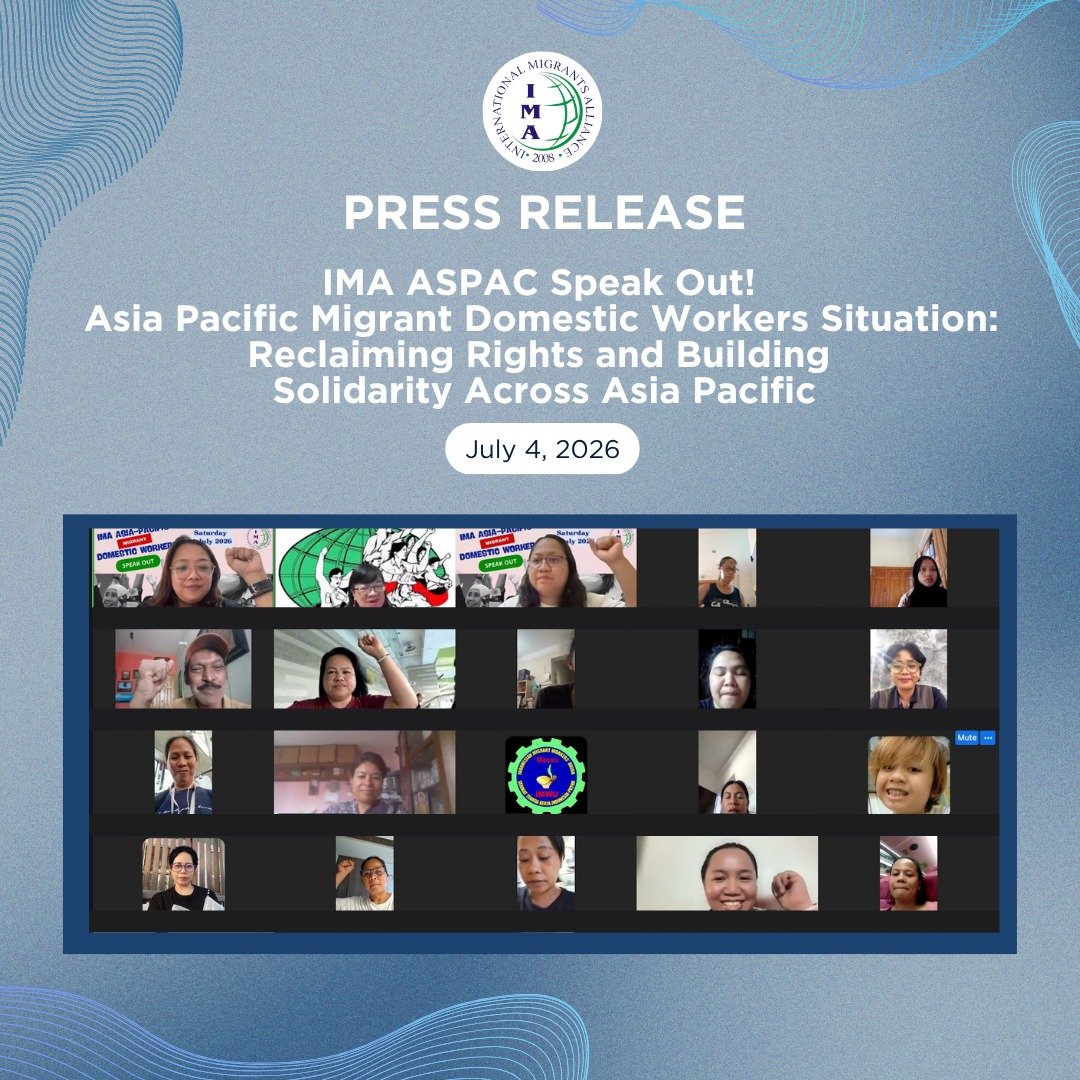
July 8, 2026 — The International Migrants Alliance Asia Pacific (IMA ASPAC) is calling for stronger protection of the rights of migrant domestic workers in the Asia-Pacific region and urging countries to ratify and implement ILO Convention No. 189 on Decent Work for Domestic Workers. This call was made during the forum “IMA ASPAC Speak Out! Asia Pacific Migrant Domestic Workers Situation: Reclaiming Rights and Building Solidarity Across Asia Pacific,” held online on Saturday, July 4.
The forum brought together activists, grassroots migrant worker organizations, domestic workers’ unions, and civil society organizations from various countries of origin and destination for migrant workers in the Asia-Pacific region. The event served as a space for migrant domestic workers to share their experiences regarding various forms of exploitation they face, while also strengthening solidarity and cross-border advocacy strategies.
The Asia-Pacific region has the largest number of domestic workers in the world. It is estimated that there are approximately 21.5 million domestic workers, or more than 40 percent of the world’s total domestic workforce. The vast majority of them are women, indicating that domestic and care work remain heavily influenced by gender inequality.
Despite their significant contributions to families, communities, and the economy, migrant domestic workers remain one of the most vulnerable groups of workers when it comes to rights violations. They often face low wages, long working hours, no days off, unsafe working conditions, lack of social security coverage, and restrictions on their freedom of association and expression.
IMA ASPAC assesses that this vulnerability stems not only from exploitative practices in the workplace but also from labor policies and migration governance that continue to view domestic work as low-value labor. As a result, domestic workers are often excluded from various forms of legal protection enjoyed by other sectors of the workforce. This situation is further exacerbated by rising living costs, uncertain working conditions, shrinking civic space, and growing anti-migrant sentiment in various countries.
At the forum, representatives of migrant domestic workers’ organizations from Indonesia, the Philippines, Bangladesh, Nepal, Hong Kong, Macau, and Taiwan presented updates on the situation in their respective countries and discussed various strategies for organizing, policy advocacy, and strengthening regional solidarity. The forum also featured a jaranan dance performance by Indonesian migrant workers in Hong Kong as a symbol of cultural preservation and solidarity among migrant worker communities.
Through this forum, participating organizations reaffirmed their shared commitment to combating labor exploitation, discriminatory migration regimes, and labor policies that continue to exclude domestic workers from legal protections. They also called for the fulfillment of a living wage, fair working hours, safe and dignified working conditions, universal labor protection, and the ratification and effective implementation of ILO Convention No. 189, which guarantees the basic rights of domestic workers, including legal protection, social security, rest periods, and freedom of association.
IMA ASPAC emphasizes that migrant domestic workers must be key actors in every policy-making process concerning their lives and rights. The workers’ firsthand experiences are considered a vital foundation for building a migration system that is fair, respects human rights, and guarantees decent work for all migrant domestic workers in the Asia-Pacific region.
IMA ASPAC calls on governments, international organizations, labor unions, civil society organizations, and all stakeholders in the Asia-Pacific region to strengthen their commitment to protecting the rights of migrant domestic workers. According to the organization, cross-border solidarity is key to ending exploitation, eliminating discrimination, and realizing decent work for all migrant domestic workers.
IMA ASIA PACIFIC